U.S. evidence review · September 2026
What happens after a child product recall is announced?
Publishing a notice is only the first step. A family still has to receive it, recognize an item that may be at home, verify the exact model or lot, and complete the official remedy. This page explains what current CPSC, FDA, and NHTSA evidence shows about that process.
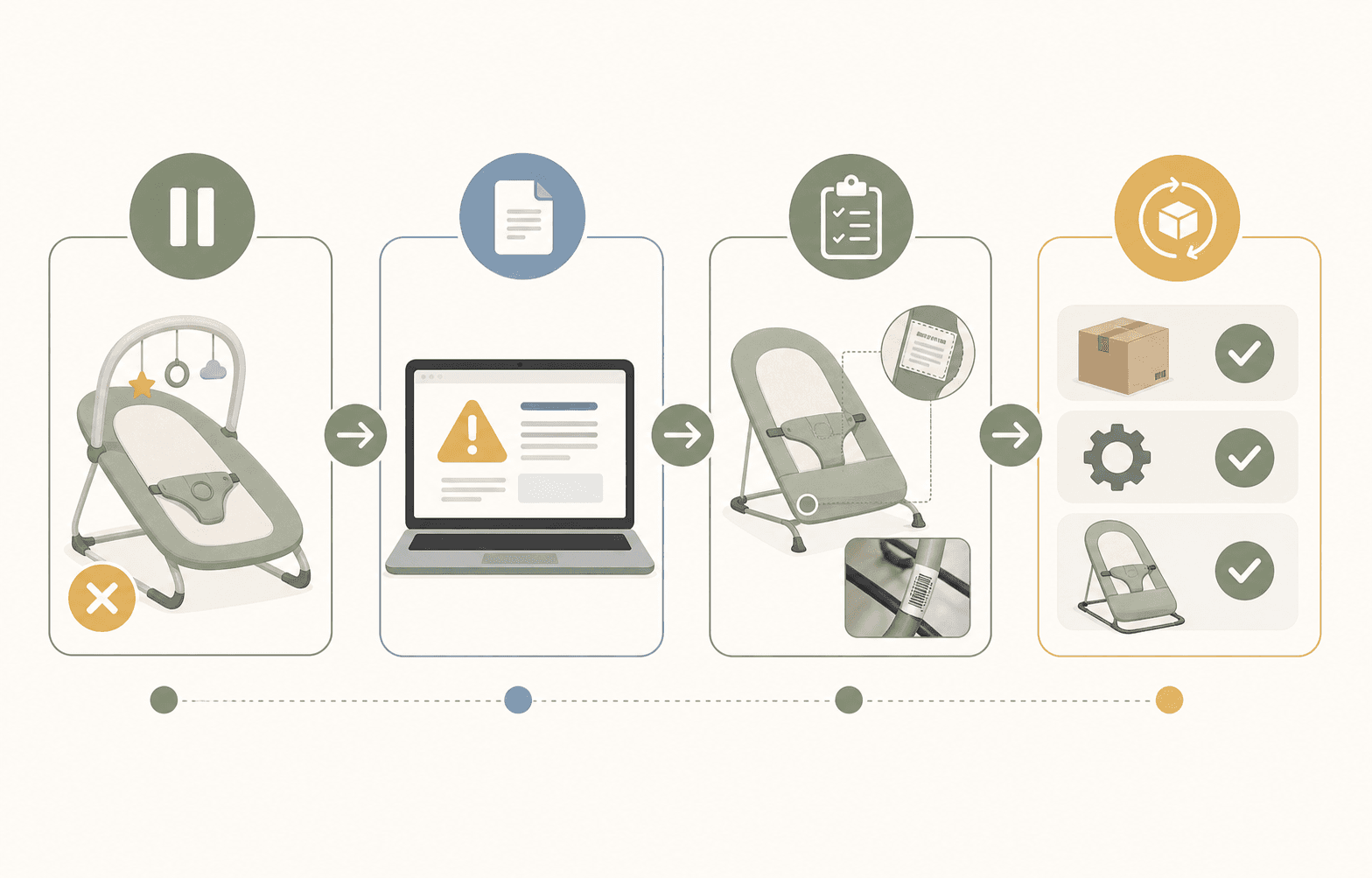
The evidence supports treating a recall as a sequence: notice, recognition, exact-item check, and official action.
The scale, kept in context
Three numbers worth understanding separately
These figures use different counting units. They should not be added together or treated as the odds that a product in one home will be recalled.
136
children's-product CPSC announcements in 2025
An independent classification of announcements, not a count of injured children or affected homes.
Source [1]26
NHTSA child-seat campaigns from 2021 through 2025
Five years of official campaign data, kept separate from CPSC announcement counts.
Source [2]1.80 million
affected seats across those 26 campaigns
A calculated campaign total, not 1.80 million unique children, families, or injuries.
Source [2]From notice to remedy
The announcement does not finish the work
A notice is published
An agency, manufacturer, or retailer releases recall information, sometimes through more than one channel.
A family recognizes the product
The notice has to connect to an item that may still be in a home, car, diaper bag, or another caregiver's care.
The exact item is checked
Model, lot, UPC, date, lane, serial number, or another detail may decide whether the recall applies.
The official action is completed
The family follows the recall-specific stop-use, repair, refund, replacement, or medical guidance.
Frequency and scale
Different agencies measure different things
CPSC announcement counts describe a recurring stream of children's-product notices. NHTSA's child-seat data describe campaigns and affected seat populations. Neither is a count of injuries or unique families.
CPSC children's-product announcements
Independent classifications
Some announcements expand or repeat an earlier recall. The 44.7% increase in announcement volume is not a demonstrated increase in a child's injury risk.[1][9]
NHTSA child-seat campaigns
Official 2021–2025 series
The five-year sum is 26 campaigns and 1,795,744 affected seats. A seat or household could be represented more than once.[2]
Follow-through
Child-seat recall completion is measurable
NHTSA publishes average completion rates for child-seat recall-year cohorts. The figures show that publishing a campaign does not automatically produce a completed remedy.[2]
Publication and expansions
A recall can change after the first notice
Manufacturer announcements, agency postings, reminders, and scope expansions can carry different dates. These examples are documented intervals, not an average delay for every recall.
GreenWise baby-food pouches
13 daysFirstCompany announcement: May 9, 2025
LaterFDA posting: May 22, 2025
One publication channel can carry the notice before another.
Gerber Soothe N Chew
77 daysFirstOriginal recall: January 31, 2025
LaterRetail reminder: April 18, 2025
A repeat warning can add useful information without being a new recall.
Sprout Organics puree
7 daysFirstInitial notice: one lot
LaterExpanded notice: four lots
A product that did not match at first may match after the scope changes.
ByHeart infant formula
3 daysFirstInitial recall: November 8, 2025
LaterAll-product expansion: November 11, 2025
A lot-limited recall can become an all-batches recall.
FDA examples
Child-focused food recalls do not all look alike
The updated evidence set spans mechanical choking, lead, microbial contamination, patulin, and packaging contamination. It is a selected set of examples, not a national FDA pediatric recall count.
Choking complaints
Gerber edible teething sticks
An edible child product can involve a mechanical hazard within FDA oversight.
Source [4]Elevated patulin
Tippy Toes baby food
One lot of fruit puree added a mold-derived toxin example to the evidence set.
Source [7]Microbial contamination
Little Remedies cough syrup
The product name sounds medicinal, but FDA categorized this notice as Food & Beverages.
Source [6]Potential soft plastic
Peter Rabbit fruit puree
The affected pouches require more than a product-name match.
Source [8]Identification
A product name is often only the beginning
The information needed to confirm a recall varies by product. A responsible result should say what matches, what remains unknown, and when the official information was last checked.
“No match found” is not a safety certification.
It means the known details did not match the monitored recall information as of a stated time.
Peter Rabbit puree
Check: Barcode, lane number 4, and six specific best-before dates
A matching barcode alone does not establish that a pouch is recalled.[8]
Sprout Organics puree
Check: Product variety and the expanded list of lot codes
A later expansion can change a previous nonmatch.[5]
Nuna RAVA car seat
Check: Model, manufacture date, and affected design characteristics
A retailer's broad product title is not enough.[21]
Time before recall
Different dates answer different questions
A manufacturing date, shipment date, retail-sales window, family purchase date, public notice, and regulatory filing are not interchangeable. The evidence does not establish one national purchase-to-recall average for every baby product.
| Example | Clock being measured | Documented interval | How to read it |
|---|---|---|---|
| Lead-related children's products[20] | Time on market before recall | Mean 25 months; range 1–73 months | A study of 30 CPSC recalls, not an all-product purchase-to-recall average. |
| Perrigo infant formula[11] | Stated shipment starts to announcement | 184–188 days | Shipment dates are not verified family purchase dates. |
| Nuna RAVA car seat[21] | Production endpoints to regulatory filing | About 13 months–8.4 years | Production and filing dates measure a different clock than retail purchase. |
| Peter Rabbit puree[8] | Retail sales-window endpoints to announcement | 8–137 days | A sales window does not reveal the average purchaser's interval. |
After publication
A public notice does not end exposure by itself
After the ByHeart formula recall, FDA and its partners made more than 4,000 retail checks and found recalled formula at more than 175 locations in 36 states. One finding occurred more than three weeks after recall. These are historical findings, not a claim that the product remains on shelves today.[14]
The figures do not support dividing 175 by 4,000 to create a national store-failure rate.
Serious harm can also be reported after an announcement
CPSC's 2023 Rock 'n Play reannouncement reported at least eight fatalities that reportedly occurred after the original 2019 recall. The manufacturer could not confirm the circumstances or product identity in some reports.[23]
This supports continued follow-through after a notice. It does not establish that each caregiver missed the recall or that an app would have prevented every death.
What parents can do
Keep enough detail to recognize the product later
Keep a product record
Include products that were purchased, gifted, handed down, bought secondhand, or used at another caregiver's home.
Save the identifying details
Photograph labels and keep the model, lot, UPC, serial number, and manufacture or best-before date when available.
Check again when a notice changes
An expansion can add products or lots that were not included in the first announcement.
Use the official instructions
Follow the notice-specific remedy. Medicines and medical devices may require guidance from a pharmacist, prescriber, or care team.
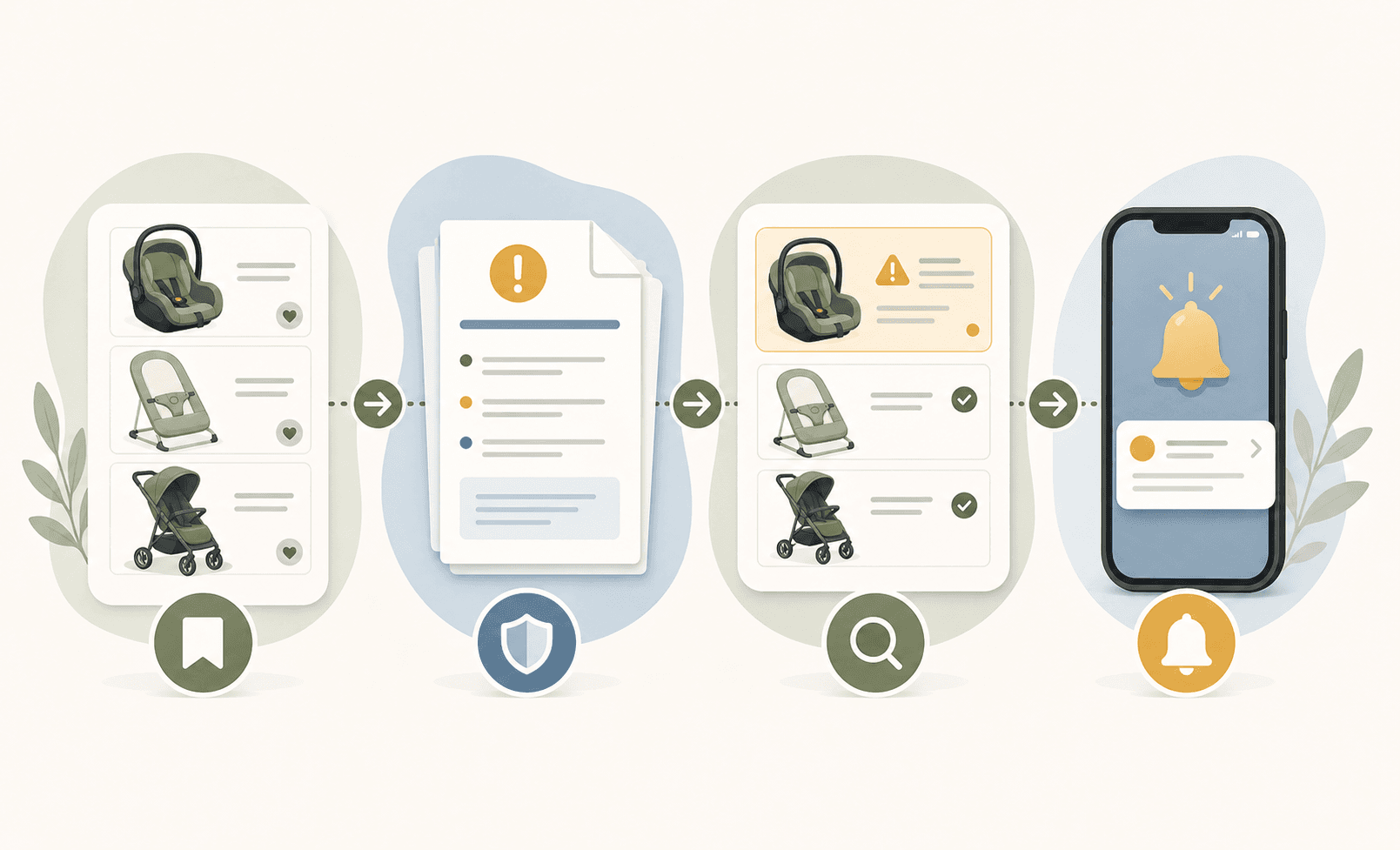
Monitoring keeps a product list available for later checks. It does not certify that an item is safe or replace manufacturer registration and official guidance.
How Baby Recall Tracker helps
Keep the product record ready for later notices
Baby Recall Tracker lets families save product details and review possible matches against monitored official recall information. Free accounts can add products manually, by barcode, or from a packaging photo. Tracking+ can also add eligible purchases from connected Gmail or Outlook order emails.
Methods and sources
Read the evidence behind this summary
This page summarizes a targeted primary-source review through September 21, 2026. It is not a systematic review or a fresh census of every recall. The newest complete annual count used is 2025, and selected 2026 examples are not annualized.
Show all references used for the evidence review
- [1]2025 independent analysis of consumer product recalls
- [2]NHTSA 2025 Annual Report: Safety Recalls
- [3]FDA-hosted GreenWise baby-food pouch announcement
- [4]Nestle USA / Gerber Soothe N Chew recall and reminder
- [5]FDA-hosted Sprout Organics expanded recall
- [6]FDA-hosted Little Remedies Honey Cough Syrup announcement
- [7]FDA-hosted Tippy Toes fruit puree announcement
- [8]FDA-hosted Peter Rabbit Organics fruit puree announcement
- [9]2024 independent analysis of consumer product recalls
- [10]CPSC FY 2025 Agency Performance Report
- [11]FDA-hosted Perrigo infant-formula announcement
- [12]FDA-hosted initial Sprout Organics recall
- [13]FDA infant botulism outbreak investigation
- [14]FDA recall-effectiveness action after the ByHeart investigation
- [15]FDA-hosted expanded infant ibuprofen recall
- [16]FDA Avanos feeding-tube kit recall
- [17]FDA jurisdiction overview
- [18]FDA Enforcement Report information and definitions
- [19]FDA Enforcement Reports
- [20]Pediatrics study of lead-related children's-product recalls
- [21]Nuna RAVA Part 573 Safety Recall Report 24C-002
- [22]CPSC Fisher-Price Snuga infant swings recall
- [23]CPSC Rock 'n Play recall reannouncement
- [24]FDA consumer guidance for drug recalls
- [25]openFDA food-enforcement overview
- [26]FDA iRES API documentation
- [27]NHTSA datasets and APIs
- [28]FDA letter on recall communication for children's foods
- [29]NHTSA car-seat registration and recall guidance
- [30]NHTSA SaferCar app